
Water Bags vs Steel Weights: Which Is Right for Your Proof Load Test?


Most proof load test enquiries start with the same question: water bags or steel? Both methods can be compliant, both can be the right answer, and both have situations where they fall short. The decision depends on your asset, your site, and the constraints around the job.


Method Comparison at a Glance
 Water BagsvsSteel Weights
Safety
✓ Progressive loading
Pause at any stage
 
Larger increments
More crane movements
Logistics
✓ Transport empty
Create load on site
 
Transport heavy mass
Laydown space required
Load Cell
Required
Volume ≠ proof load
 
Recommended
Adds traceability
Marine Use
✓ Often preferred
Suits tight spaces
 
Less practical
On vessels
Best Fit
Marine, port, remote,
in-situ, access-constrained
 
Fixed test beds,
workshop, repeat setup

The basic difference

Steel weights apply a known mass using solid test blocks or fabricated counterweights. They are familiar, robust, and well suited to controlled environments where the test setup is repeatable and handling equipment is already in place.

Water bags achieve the test load by filling purpose-designed bags with water on-site, usually while the test item remains in position. This allows the load to be built progressively until the required proof load is reached — without transporting heavy solid masses to the test point.

Steel weights move the mass to the site. Water bags create the mass on the site.

That difference can reduce freight, handling, setup time, and congestion around the test area.
Safety: progressive loading matters

One of the biggest advantages of water bags is the ability to increase load gradually. Instead of lifting and landing multiple heavy steel blocks to build up the test weight, operators fill the bags in controlled stages and monitor the response as the load rises.

That progressive approach gives the team more control. If there is any unexpected movement, deformation, or concern in the rigging arrangement, the test can be paused. The load does not have to be committed all at once.

Steel weights are often applied in larger increments — which can involve more crane movements and more potential for sudden load changes during placement or settling. In tight spaces or awkward access conditions, that increases operational complexity.

For in-situ proof testing, water bags often provide a safer and more manageable way to build the load. That said, safety still depends on proper engineering, rigging design, exclusion zones, and competent supervision. Water bags are not a shortcut around planning.

Logistics: fill on site or transport heavy steel?

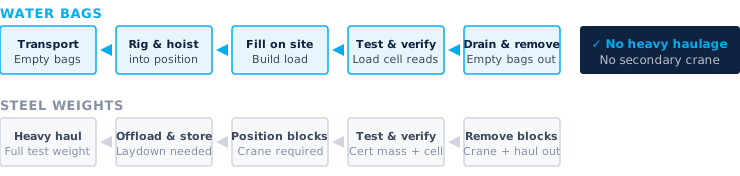
Steel weights must be transported to site, offloaded, stored, moved into position, and then removed again once testing is complete. For high-capacity proof loads, that can mean a significant transport task, additional crane time, and valuable laydown area taken up by test blocks.

Water bags are much easier to mobilise. Empty bags are compact and can be delivered with far less transport burden. Once on site, they are filled using available water and drained after the test.

Logistics — Two Different Models

Flow chart showing logistics between water bags and steel weights

Water supply and drainage matter. Water bags rely on a suitable water source, a controlled filling process, and a practical drainage plan. If water supply is limited, environmental controls are strict, site drainage is constrained, or temperatures create freeze risk, steel may be the more straightforward solution. Confirm site conditions before committing the method.

Headroom and geometry

Before selecting water bags, confirm that the rigging geometry, headroom, and sling arrangement will work for the job. Standard bags require clearance to hang and unroll freely. Low-headroom bag variants are available for more constrained environments — typically up to 15 tonnes — but headroom, lift points, and support clearance must be assessed first regardless of which format is used.

If the geometry does not suit a hanging bag arrangement, steel weights may offer a simpler path to the same proof load in that specific scenario.

Accuracy: use a calibrated load cell

Whichever method you choose, accuracy should not be assumed. A common mistake is to treat nominal bag volume or marked steel mass as the final proof load. In reality, the only reliable way to confirm the actual test load in the rig is with a calibrated load cell.


Why a Calibrated Load Cell Is Non-Negotiable
WITHOUT load cell (water bags)
Fill volume = estimated load only
Not traceable · Not auditable
✗ Does not satisfy proof load evidence requirement
VS
WITH calibrated load cell (either method)
Direct measurement of applied load
Traceable · Auditable · Defensible
✓ Proof load verified and recordable
The method is not "bag versus steel" — it is "bag or steel, verified by calibrated instrumentation."

When steel is still the better choice

Water bags are highly versatile, but steel weights are not obsolete. Steel can still be the better option when:

  • the test is being done in a controlled yard or fabrication facility with permanent handling plant
  • the same proof load setup is used repeatedly on similar items
  • water supply, drainage, or environmental conditions are not suitable
  • headroom or geometry does not suit a hanging bag arrangement
  • smaller, simpler tests do not justify a water bag mobilisation

Choosing the right method

The right proof load testing method depends on the asset, the site, the load, and the constraints around the job. If you need flexibility, progressive loading, and easier mobilisation for an in-situ test, water bags are often the smarter choice. If you are working in a fixed test environment with repeatable setups and permanent handling plant, steel weights may still make excellent sense.

The best outcome comes from selecting the method that reduces risk, suits the site, and delivers a verified, traceable result — regardless of which load medium you use.

Need help deciding which method suits your site, load, and compliance requirements?

Speak to the team